


a Castle story
Giggle. Cuss. Drink. Repeat.
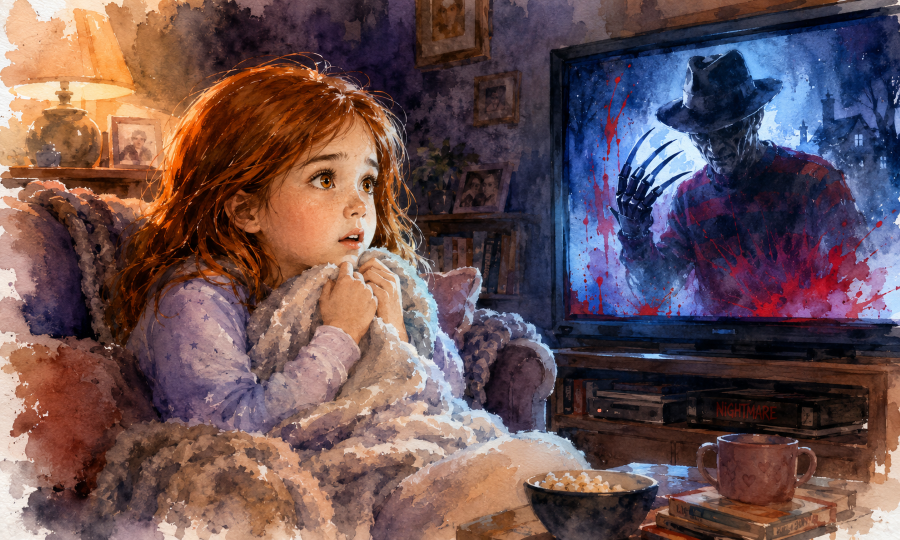
07: Freddy’s Coming For You
What are your sepia-toned memories of childhood?
You know the ones.
Those memories that play out like the opening scenes of a Stephen King adaptation or a Lipton iced tea commercial. The kind with bicycles tossed onto front lawns, sticky popsicle fingers, sprinklers hissing in the grass, and mothers calling children in for dinner before the streetlights came on.
Maybe yours is riding bikes with your friends until your legs ached. Maybe it’s your mum’s chocolate chip cookies. Maybe it’s visits to your grandparents’ alpaca farm, because apparently some people got childhoods with livestock and emotional stability. Good for them. Truly. No notes.
Chances are, it is something sweet and heart-warming. Something you can share with your own kids while soft music plays in the background and everyone pretends nostalgia is not just memory with a flattering filter.
Like, “When I was a little girl, I double-dutch jump-roped with my best friend in front of our houses while our parents barbequed in the backyard.”
That sort of thing.
Those were not Evelyn Harlow’s sepia-toned memories.
Sure, Evie played out in the street with the neighborhood kids sometimes. She knew how to run barefoot on hot pavement. She knew the slap of a screen door, the smell of cut grass, the electric thrill of being outside at dusk when the sky went purple, and every kid in the neighborhood suddenly became part wolf.
But the other kids had to go home when the streetlights came on.
Evie did not.
There was usually nobody home to care, and there was definitely no dinner waiting. Sort of takes the joy out of frenzied twilight play when everyone else disappears into houses with porch lights and casseroles, and one little girl is left standing in the street like an unpaid extra in a movie about neglect.
Evie’s best childhood memories were not the opening scenes of a Stephen King adaptation.
They were the final scenes.
Or better yet, Wes Craven.
Because when real life isn’t so great, there is nothing more satisfying than watching a promiscuous co-ed get punished for taking her bra off in the woods. Not because Evie understood any of it. She did not. She was nine years old. Sex in movies was just weird adult gymnastics that usually meant someone was about to die. Which, honestly, is a harsh lesson but not the worst summary of the 1980s.
Evie loved horror movies.
Not in the cute way kids like Halloween. Not plastic pumpkins, fun-size candy bars, and a witch hat from Woolworth’s. Evie loved the truly inappropriate stuff. The slashers. The haunted houses. The girls screaming in nightgowns. The teenagers making decisions so stupid they should have counted as volunteer work for the killer.
Freddy. Jason. Michael Myers. Leatherface. Possessed houses. Psychic children. Sorority girls. Summer camps. Wrong turns. Dead mothers. Bad dreams. Bathrooms you should not open. Basements you should not enter. Attics you should burn to the ground as a precaution.
Evie loved them because they made sense.
That is probably not what people expect. Horror movies are supposed to be scary because monsters are not real. That is the whole comfort of it, right? You watch the nightmare, then turn off the television and return to safety.
Cute theory.
Very Hallmark.
For Evie, horror movies were comforting because the monsters had names.
They had theme music. They had rules. They had weaknesses. They had a beginning, middle, and end. Sometimes they came back for a sequel, but even then, they had the decency to wait until the next tape.
Real life was not that polite.
Real life did not have a soundtrack warning you that something bad was coming. Real life did not cut to a close-up of the doorknob turning. Real life did not make Evie the girl with a weapon or a conveniently placed boat motor.
Real life just opened the door.
Single-mum brothels do not have a lot of things like food or toiletries, but they do have expensive electronic devices that married suitors could more easily gift than cash. So Ruby’s house was one of the first with a VCR.
No reliable groceries.
No consistent supervision.
No bedtime.
But they had a VCR.
The 1980s were a magical time.
Evie had a routine. Ruby would give her money, and Evie would walk down to Thrift Drug to buy her cigarettes and alcohol, because apparently the 1980s operated on the legal theory of “close enough.”
No one asked questions.
They knew who Evie was. They knew she was Ruby’s kid. They knew the cigarettes were for Ruby, the alcohol was for Ruby, and the small child standing at the counter was just the delivery system. Evie was not strolling through town with a responsible adult. She was not holding anyone’s hand. She was a little girl on an errand, carrying money from her mother and responsibilities that should have required a union card.
And as long as Evie rented something for Kit too, Ruby did not seem to care what else came home with her.
So Evie bought the cigarettes. She bought the alcohol. She picked out something soft and sweet for her little sister.
Then she rented a horror movie that should have required a priest, a waiver, and possibly a note from the governor.
Nobody cared.
That is important.
Nobody looked at Evie, a child barely tall enough to reach the counter, and said, “You know what? I do not think this little girl should be renting Nightmare on Elm Street.”
Nobody asked, “Is your mother nearby?”
Nobody said, “Maybe Porky’s is not appropriate for someone who still watches cartoons with her little sister.”
Nobody said anything.
It was the 80s. You could send a child into a store for cigarettes and a movie full of nudity and ritual slaughter, and the clerk would just hand it over like, “Have a nice night, tiny traumatized citizen.”
There was no Blockbuster yet. No bright blue and yellow temple of late fees. No rows and rows of plastic cases under fluorescent lights. Thrift Drug had this metal poster rack, the kind that stood upright and held big laminated pages Evie could flip through one at a time. Each page had movie posters or cover images. Two or three per page, maybe more, depending on how much visual sin they could cram into one metal frame.
Evie would flip through them like she was browsing mugshots.
There would be a number on each movie. She would remember the number or write it down or point to it with the grim confidence of a mob boss ordering a hit, and then she would go up to the counter and ask for the tape.
That was it.
That was the gatekeeping.
“Number forty-seven, please.”
And some adult, theoretically part of civilization, would hand a nine-year-old a horror movie with a cover that looked like the inside of a serial killer’s lunchbox.
Evie always rented two movies.
One for herself.
One for Kit.
Kit was younger than Evie, and Evie had enough sense to realize her little sister should not be watching what she watched. This is not to suggest Evie had a full grasp of childhood development or responsible caregiving. She was a child. She also thought blankets could stop murderers. But she knew Kit needed something sweet. Something soft. Something with bears or ponies or strawberry-scented optimism.
So Evie would pick out some insane horror movie for herself, and then something like Care Bears for Kit.
Balance.
A family value.
Evie would bring the movies home, along with whatever food she had managed to buy, and they would watch Kit’s movie first. That part was fun. They would sit in the living room, make jokes, laugh, eat whatever they had, and pretend for a little while that they were normal kids in a normal house doing normal kid things.
Care Bears were safe. Care Bears lived in clouds and solved problems with feelings projected from their stomachs, which honestly seems medically concerning but emotionally aspirational.
Kit loved them.
Evie loved that Kit loved them.
Then Kit would go upstairs to bed.
And Evie would put in the other tape.
Sometimes she watched alone.
Sometimes Valentina came over.
To Evie, she was Val, and Val was the coolest teenage girl who had ever existed. She was the kind of girl movies invent so little girls can worship them from across the room. Bleached blonde hair with dark roots. Jean jacket with bedazzled details. Cigarettes. Music. Confidence. The casual slouch of someone who seemed to know every secret of the universe and had decided most of them were boring.
Val was sixteen, or somewhere around there. Old enough to drive. Old enough to seem ancient to Evie. Evie was nine, which meant Val was basically a glamorous elder stateswoman with lip gloss.
She drove a white convertible LeBaron with a red interior. Her father had given it to her. Evie would remember that car like a religious event. White outside, red inside, top always down, music spilling out, cigarette smoke curling into the wind.
Val played all the 80s music Evie loved, which made Evie love it more because Val liked it. That is how worship works when you are a lonely little girl. Someone cooler than you validates a thing, and suddenly that thing becomes holy.
Evie wanted to be beautiful like her. Cool like her. Teflon like her.
That is the word she would have used if she had known it then.
Teflon.
Nothing stuck to Val.
Of course, that probably was not true. Girls like Val are often not Teflon at all. They are just very good at looking shiny while the pan burns underneath. She was a sixteen-year-old hanging out with a nine-year-old because Ruby’s house had alcohol and no supervision. That is not glamour. That is a red flag in a jean jacket.
But Evie did not know that.
Evie thought Val had chosen her.
Val was kind to Evie. That matters. She treated Evie like an equal, like they were just friends. Not a babysitting job. Not some annoying kid she got stuck with. A friend. And when a child is small and hungry and mostly raising herself, being treated like a person can feel like being crowned queen of something.
Val would come over and smoke in the house because everyone smoked in the house. Ruby smoked in the house. Men smoked in the house. The house itself probably smoked when no one was looking.
Val drank sometimes. Evie drank sometimes too, but not like a party girl. Not for fun. Not yet. She was not sneaking sips because she wanted to feel grown-up. She was drinking to make things hurt less, which is a sentence that should not belong to a child, but here we are.
They would sit on the couch under piles of blankets with the lights still on because they were brave but not stupid.
Blankets, as everyone knows, are one of childhood’s most important defense technologies. They protect you from monsters, ghosts, serial killers, demons, drafts, and the crushing realization that the adults have completely failed.
They watched everything.
Friday the 13th. Nightmare on Elm Street. April Fool’s Day. Haunted house movies. Slasher movies. Movies with girls in showers and boys in varsity jackets and adults who were either useless, dead, drunk, possessed, or all four. Porky’s was not horror, technically, but it could have been. A lot of 80s teen comedy feels like something a therapist would need to process with a whiteboard and a sedative.
Evie remembered pieces of movies more clearly than she remembered entire years of her life.
Sometimes, she did not even know what movie a scene came from. There was one that never left her. A house full of girls, she thought. Someone opened a bathroom door, and there was a head in the toilet.
That was all she had.
A door.
A bathroom.
A head in the toilet.
No title. No plot. No context. Just a little souvenir her brain kept in a drawer for forty years because, apparently, memory is less like a filing cabinet and more like a raccoon with a flashlight.
Evie remembered those scenes more accurately than she remembered why she walked into a room today.
Horror branded her.
Not because it was the worst thing she had seen but because it gave her pictures for what fear felt like.
Kit was supposed to be upstairs during the scary movies, but houses are not divided into neat little kingdoms of safe and unsafe. Not houses like Ruby’s. Upstairs was not safe for Evie. Upstairs was where her bedroom was, and a bedroom should be a place where a child can sleep without fear. Hers was not. A closed door did not mean protection. A bed did not mean rest. Being tucked in did not mean anyone was keeping watch.
So downstairs on the couch, watching some co-ed get hacked to death by a deranged killer, often felt safer than going upstairs to bed.
That sounds impossible unless you have lived in a house where the imaginary monsters were better behaved than the real ones.
Kit would sneak down sometimes.
She knew Evie and Val were watching something else. Something forbidden. Something not made of rainbows and plush bears with stomach lasers. The townhouse had a stairwell where Kit could creep down just far enough to see part of the living room. From there, she could see the couch. She could see a slice of the television.
They did not let her come down.
But she saw pieces.
Enough pieces.
She saw snippets of Nightmare on Elm Street, and to this day, Kit is a grown woman who is terrified of Freddy Krueger.
Evie feels bad about that.
Not bad enough to stop telling the story, obviously, because she is still Evie. But bad.
Freddy got Kit through the railing.
That was the thing about horror. It leaked.
Evie could try to keep it contained. She could send her little sister upstairs with the Care Bears. She could tell herself Kit was fine, that she was managing it, that she was the one taking the scary part because someone had to.
But fear has excellent ventilation.
It got through the stairwell. It got under doors. It got into dreams. It got into them.
Still, Evie watched.
She watched because those movies made her life feel not as bad as it could be.
That is the ugliest kind of comfort, but it was comfort.
Evie was not being chased through the woods by a man in a hockey mask.
She was not hung on a meat hook by a guy wearing someone else’s face.
She was not trapped in a house that bled from the walls.
She was not being dragged into a nightmare by a burned man with knives for fingers.
See?
Fine.
Everything was fine.
Childhood math is not always accurate, but it is efficient. If nobody is actively chainsawing you in half, maybe things are okay. If there is no severed head in the toilet, maybe your bathroom is safe enough. If you wake up and your body is still attached to your body, congratulations, princess, another successful night in the kingdom.
This is not cute.
Evie believed it.
Or she needed to believe it.
Horror gave her a worse world to compare hers against. Other people were being stalked, stabbed, possessed, decapitated, drowned, buried, resurrected, and chased through abandoned summer camps by men who really needed hobbies.
Her life was not that bad.
Right?
No, sweetheart.
That was not perspective.
That was survival math.
But survival math kept her alive, so it is hard to insult it too much. It was doing its best with terrible numbers.
After the scary movie ended, the room always felt different.
The credits would roll. The VCR would clunk. The house would be quiet in that bad way houses get quiet at night, when every pipe and wall crack suddenly develops a personality. Val might already be half-asleep on the couch, cigarette smell in her hair, one arm outside the blanket like she was not worried about anything in the world.
Evie was worried about everything in the world.
She would lie there, frozen, listening.
Every shadow became a possible man.
Every creak became a footstep.
Every dark doorway became a mouth.
And then, because Evie had done this to herself and had no adult to fix it, she would put Kit’s movie back on.
Care Bears. My Little Pony. Some soft cartoon where nobody’s head ended up in a toilet. Something pastel and gentle and aggressively committed to the lie that love was enough to defeat evil.
Evie needed that lie too.
She would watch until her heart slowed down. Until the couch felt less like a raft in the middle of a black ocean. Until the shadows stopped sharpening their teeth.
Then she would fall asleep there.
On the couch.
Under the blankets.
With the television still glowing.
Evie slept downstairs because downstairs had the TV. Downstairs had the tapes. Downstairs had the couch and the blankets and the lights she could leave on. Downstairs had Freddy, yes, but Freddy stayed in the machine.
Upstairs had no such manners.
Morning always felt brighter.
That sounds obvious. Morning is brighter. Science really nailed that one.
But the house felt brighter because they had not been killed.
The sunlight would come in, and the room that had been full of shadows and murder the night before became a regular messy living room again. The couch was just a couch. The television was just a television. The blankets were just blankets.
Val would wake up and leave, if she was there. Maybe she would light a cigarette. Maybe she would fix her hair. Maybe she would climb back into that white convertible with the red interior and drive away with the top down, already becoming a story before she hit the end of the street.
Kit would come downstairs, alive and mad or hungry or still humming something from the cartoon.
Evie would be alive too.
That counted.
Nobody had come out of the television.
Nobody had dragged her into a boiler room.
Nobody had burst through the wall in a mask.
Nobody had carved her into a cautionary tale.
The monsters had stayed where they belonged.
The real ones were less considerate, but morning was not the time to think about that. Morning was for returning the tape. Morning was for acting like the night had not done anything to them. Morning was for eating whatever they had and pretending childhood was something you could pause, rewind, and start over.
Ruby may or may not have known what they were watching.
Ruby may or may not have known what they were doing.
Ruby may or may not have known much of anything ever.
That sounds cruel.
It is also accurate.
Ruby was not checking ratings. Ruby was not asking what Evie had rented. Ruby was not saying, “Maybe my small child should not be watching a burned man murder teenagers in their dreams.”
Ruby was elsewhere, even when she was there.
So Evie watched horror movies.
She watched them too young, too often, too intensely. She watched them with her hands near her face and her body tucked under blankets. She watched them with Val beside her and Kit sneaking glimpses from the stairs. She watched them because they scared the absolute hell out of her, and somehow that helped.
The fear had a shape.
That was the gift.
Freddy had a hat. Jason had a mask. Leatherface had a chainsaw. Haunted houses had fog and bad real estate decisions. Even the severed head in the toilet had the courtesy to be memorable.
Evie’s real fears were harder to draw.
Hunger does not always look dramatic.
Neglect does not wear a costume.
Abandonment does not kick down the door with a knife. Sometimes it just does not come home.
Abuse does not need special effects.
And that is the part people miss when they ask how a child could watch those movies and still sleep.
Evie did not sleep.
Not really.
She passed out eventually with cartoons glowing on the television because some small part of her still wanted to believe in bears who could shoot kindness from their bellies and make the world behave.
But horror told the truth first.
Horror said the house is not always safe.
Horror said adults are often useless.
Horror said the girl has to save herself.
Horror said sometimes the monster gets inside.
Horror said sometimes nobody believes you until there is blood on the wall.
Horror said, “You are right to be afraid.”
And as strange as it sounds, that was a relief.
Because most of Evie’s childhood required her to pretend things were normal. Smile. Be funny. Take care of Kit. Find food. Stay out of the way. Do not ask too many questions. Do not need too much. Do not make it worse.
But horror never asked Evie to pretend.
Horror looked at the world and said, “Yes. This place is dangerous.”
Finally.
A little honesty.
So when people talk about childhood memories with that soft-focus glow, Evie tries not to ruin the party. She really does. She lets them have the cookies, the bikes, the grandparents with alpacas, the parents barbequing in the yard.
Everybody deserves a nice sepia tone if they can get one.
Evie’s just happens to be the color of cigarette smoke in a dark living room, VCR static, red vinyl seats in a white convertible, and the glow of a cartoon playing after midnight because Freddy had finally gone back into the box.
And if that sounds sad, it was.
But it was also hers.
And in the morning, somehow, she was still there.

